The Roman Dodecahedron
A 2,000-year-old mystery - and SOIL's central symbol
"Like the Roman craftsman who made these objects for purposes we can only guess, organizations die and take their knowledge with them."
The Artifact
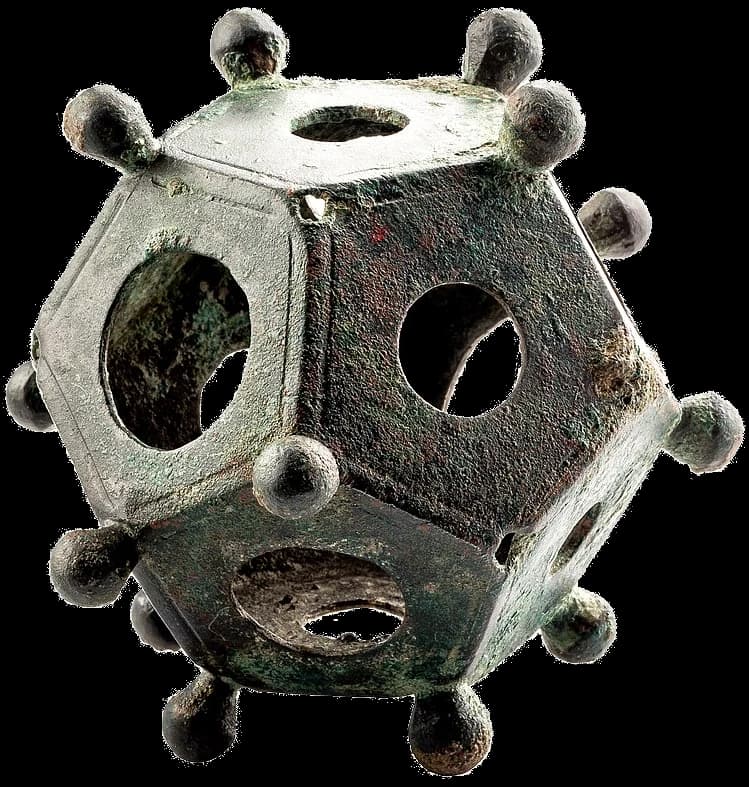
The Roman Dodecahedron is a small hollow bronze artifact, typically 4-11 cm in diameter, dating to the 2nd-4th century AD. Approximately 130 specimens have been discovered, primarily in the northwestern provinces of the Roman Empire (Gaul, Britain, Germania).
Distinctive Features
- •12 pentagonal faces, each with a circular hole
- •Holes of varying diameters (no two the same size)
- •20 vertices, each topped with a small sphere (knob)
- •Hollow interior, made of bronze or stone
- •Patinated surface showing centuries of age
The Mystery
Despite over a century of archaeological study, no Roman text mentions these objects. Their purpose remains unknown. Over 50 theories have been proposed - astronomical instrument, religious object, candleholder, military decoration, children's toy, knitting tool, divination device.
The mystery endures.
This is one of archaeology's most famous unsolved puzzles - a sophisticated artifact whose meaning was lost with its makers. Many dodecahedra have been found in burial contexts or ritual deposits, suggesting they held significant meaning to their owners - important enough to accompany them in death or to be offered to the gods.
Why This Symbol
Lost Knowledge
The Roman Dodecahedron represents knowledge that was lost - sophisticated, meaningful, carefully crafted, yet ultimately forgotten. This is precisely what SOIL fights against: the loss of organizational knowledge when ventures die.
No written records survive
→ Institutional knowledge disappears with organizations
Purpose forgotten
→ Lessons of failure rarely systematically preserved
Found in burial contexts
→ We study organizational "death"
Sophisticated craftsmanship
→ Organizations represent years of human effort
The Twelve Lenses
Each of the 12 pentagonal faces represents a fundamental scientific discipline that contributes to understanding organizational health and mortality.
Biology
Organization as organism - birth, growth, metabolism, death
Ecology
Populations, niches, competition for resources, environmental fit
Economics
Markets, incentives, efficiency, rational choice, firm theory
Sociology
Social structures, institutions, power, networks, legitimacy
Psychology
Behavior, motivation, cognitive limits, leadership, burnout
Political Science
Power, conflict, coalitions, governance, decision-making
Anthropology
Culture, rituals, meaning-making, symbols, identity
Cybernetics
Feedback loops, control, self-regulation, homeostasis
Systems Theory
Wholes and parts, emergence, boundaries, complexity
Information Theory
Communication, signals, noise, coordination, entropy
Evolutionary Theory
Selection, variation, inheritance, adaptation, fitness
Medicine
Diagnosis, pathology, treatment, prevention, prognosis
The Lens Metaphor
The circular holes in the Roman Dodecahedron are not merely decorative - they are apertures of varying focal lengths. Each hole offers a different view of what lies within.
Same data. Multiple lenses. Multiple truths.
SOIL collects data in a lens-neutral format. The same organizational death can then be examined through any of the 12 lenses, revealing different aspects of the same reality.
This lens metaphor directly supports SOIL's core methodological commitment: we do not impose a single theoretical framework. We collect data neutrally and apply multiple lenses post-hoc, testing which frameworks best explain and predict organizational mortality.
Explore the Methodology
Learn more about how SOIL applies this framework-agnostic approach to organizational research and what makes our data collection unique.